
The History of AI Names: From Cybernetics to Trump’s SI
A new name is not a new capability
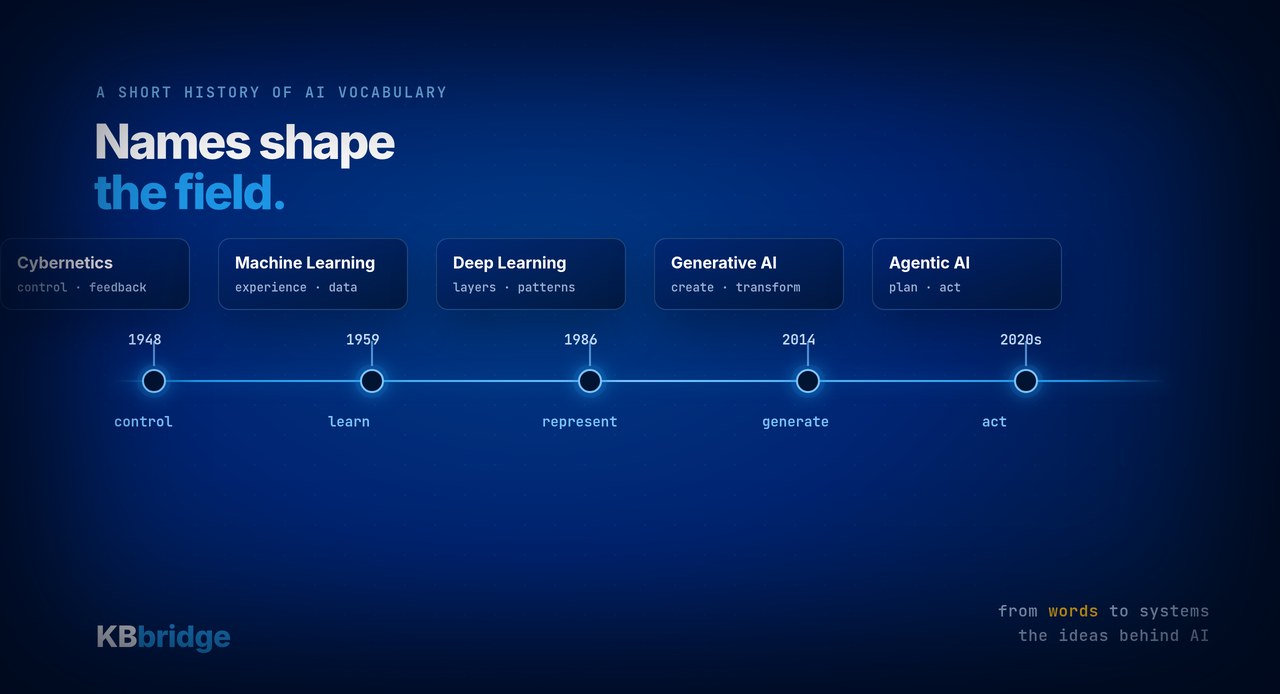
The history of artificial intelligence is also a history of names. Cybernetics, machine learning, deep learning, and superintelligence are not interchangeable labels: some describe research schools, others methods, disciplines, or hypothetical capabilities. Understanding where each term comes from helps distinguish technical advances from changes in rhetoric.
On September 29, 2026, Donald Trump ordered the US executive branch to use ‘Super Intelligence’ and ‘SI’ instead of ‘Artificial Intelligence’ and ‘AI’, within legal limits. Reactions continued into early October. Understanding the change requires separating historical terminology from demonstrated capabilities.
Cybernetics — 1948
Norbert Wiener established its modern meaning in Cybernetics: Or Control and Communication in the Animal and the Machine. The Greek root evokes a steersman: control through communication and feedback. It influenced automation, robotics, and systems theory, but is not simply an earlier name for AI.
Artificial Intelligence — 1955–1956
Coinage is credited to John McCarthy. The expression appears in the August 31, 1955 Dartmouth proposal, coauthored with Marvin Minsky, Nathaniel Rochester, and Claude Shannon for the 1956 project. It named research into language, abstraction, problem-solving, and learning. ‘Artificial’ means constructed, not fake. Dartmouth helped establish a field rather than inventing all its techniques.
Complex Information Processing — 1956
Allen Newell and Herbert Simon used it in The Logic Theory Machine: A Complex Information Processing System. It emphasized information processing and problem-solving heuristics rather than intelligence as a broad label. The approach influenced symbolic AI and cognitive science. This is a documented early use, not proof of first coinage.
Machine Learning — 1959
Arthur Samuel is commonly credited with the term, documented in Some Studies in Machine Learning Using the Game of Checkers. Learning meant improvement through experience, not the absence of programming. The name later covered many statistical and neural methods: a part of AI, not its replacement name.
Informatics — 1957 and 1962
Karl Steinbuch used the German Informatik in 1957; Philippe Dreyfus coined French informatique in 1962. The construction combines information and automation. English ‘informatics’ also has its own history. The discipline covers information processing more broadly and is not equivalent to AI.
Neurodynamics — 1961–1962
Frank Rosenblatt’s Principles of Neurodynamics: Perceptrons and the Theory of Brain Mechanisms appeared as a 1961 report and a 1962 book. The name highlights neural mechanisms and their behavior. It is a documented landmark, not proof that he invented the word. Its tradition continued in neural models and computational neuroscience.
Ultraintelligence and Superintelligence — 1965 and 2014
I. J. Good wrote Speculations Concerning the First Ultraintelligent Machine in 1965, discussing an ultraintelligent machine that could design better machines and trigger an intelligence explosion. That paper does not establish that he coined the exact word ‘superintelligence’. Nick Bostrom popularized the latter concept in Superintelligence: Paths, Dangers, Strategies (2014): capabilities greatly exceeding human performance across virtually all relevant domains. These describe a capability threshold, not any AI system.
Connectionism — revival in the 1980s
The name emphasizes networks of units and connections whose weights change during learning. Its history predates 1986; Rumelhart, McClelland, and the PDP Research Group advanced its revival with Parallel Distributed Processing. They did not invent all neural networks or the term that year. The approach expanded in cognitive science and neural learning.
Knowledge-Based Systems — 1960s–1980s
The term emphasizes explicit domain knowledge separated from mechanisms that use it. DENDRAL and MYCIN, associated with researchers including Feigenbaum, Buchanan, and Lederberg, are landmarks of expert systems. No single proven coinage is asserted here. Commercial expansion in the 1980s exposed the cost of acquiring and maintaining rules.
Deep Learning — different uses of one name
Rina Dechter used the expression in Learning While Searching in Constraint-Satisfaction Problems (1986), about search and constraints—not today’s deep neural networks. Scholarpedia’s history identifies neural-network usage in Aizenberg and colleagues’ 2000 work. In modern usage, ‘deep’ refers to multiple representation layers. Hinton and many others contributed to its expansion in the 2000s and 2010s. First use is not the same as later popularization.
Computational Intelligence — consolidation in the 1990s
It groups methods such as neural networks, fuzzy systems, and evolutionary computation. IEEE’s 1994 world congress and James Bezdek’s work are consolidation landmarks, not proof of a single birth. The label emphasizes adaptive, numerical methods; its boundary with AI varies by community.
Artificial General Intelligence — 1997 and the 2000s
An early use is attributed to Mark Gubrud in Nanotechnology and International Security (1997). Shane Legg and Ben Goertzel later helped popularize it. ‘General’ distinguishes transferable capabilities across tasks from specialized systems. AGI has disputed definitions and is not synonymous with superintelligence: generality and superiority are different dimensions.
2026: Trump makes Super Intelligence official terminology
The September 29 order, Inaugurating the Era of Super Intelligence, applies to executive-branch correspondence, communications, websites, reports, and non-statutory documents where legally permitted. Existing contracts, regulations, and historical documents need not be rewritten. Initially SI encompasses technologies covered by the existing statutory AI definition. The order also requests a proposed federal definition within 60 days; a proposal is not an enacted law.
The stated rationale combines a promise of more capable systems with opposition to ‘artificial’ sounding fake. This is a government vocabulary change, not a worldwide mandate for scientists or private businesses, and not evidence that Bostrom-style superintelligence has been achieved.
Reported reactions
- Business support: The Independent, republished by AOL on October 5, reports that Elon Musk backed SI and announced plans to rename SpaceXAI to SpaceXSI. This is an announced intention, not verification of a completed corporate change.
- Conceptual concern: The Independent’s October 2 coverage, drawing on Politico reporting, cites R Street Institute’s Adam Thierer warning that repurposing a term with an established meaning can confuse debate about capabilities and risks.
- Political interpretation: the same article attributes to Chamber of Progress’s Adam Kovacevich the view that adopting the label can signal political loyalty. That is his opinion, not a technical finding or industry consensus.
- Legal interpretation: K&L Gates distinguishes the new vocabulary from the existing legal scope. A federal communication may now say SI while referring to technologies previously called AI.
The lesson: terminology cannot replace evidence
Machine learning and deep learning name methods; AGI and superintelligence describe capability aspirations; SI in this order is an administrative label. Conflating them erases important distinctions. Evaluate what a tool does, under which tests, with what limits, and who reviews its results. That principle also applies to KBbridge workflows: a label is no substitute for review.
How you try it
Explore KBbridge through Getting Started and the 15-day free trial at kbbridge.com.
Sources
- White House: Inaugurating the Era of Super Intelligence (2026-09-29)
- The Independent: reactions to the rebranding (2026-10-02)
- The Independent / AOL: Musk’s announced renaming (2026-10-05)
- K&L Gates: legal scope (2026-10-02)
- Wiener: Cybernetics — Britannica
- Dartmouth proposal (1955), Stanford archive
- Newell and Simon: The Logic Theory Machine (1956), RAND
- Samuel: Some Studies in Machine Learning Using the Game of Checkers (1959)
- Informatics: linguistic history — Academy of Europe
- Rosenblatt: Principles of Neurodynamics (1961 report), DTIC
- Rosenblatt: Principles of Neurodynamics (1962 book)
- Good: Speculations Concerning the First Ultraintelligent Machine (1965)
- Connectionism and the PDP revival: Gibbons (2019)
- Expert systems and Feigenbaum — Britannica
- Dechter: Learning While Searching in Constraint-Satisfaction-Problems (1986)
- Deep Learning: terminology and history — Scholarpedia
- Bezdek: (Computational) Intelligence: What’s in a Name? (2016)
- AGI terminology and Gubrud — WIRED