
The signal is not the agents: it is where companies are putting them
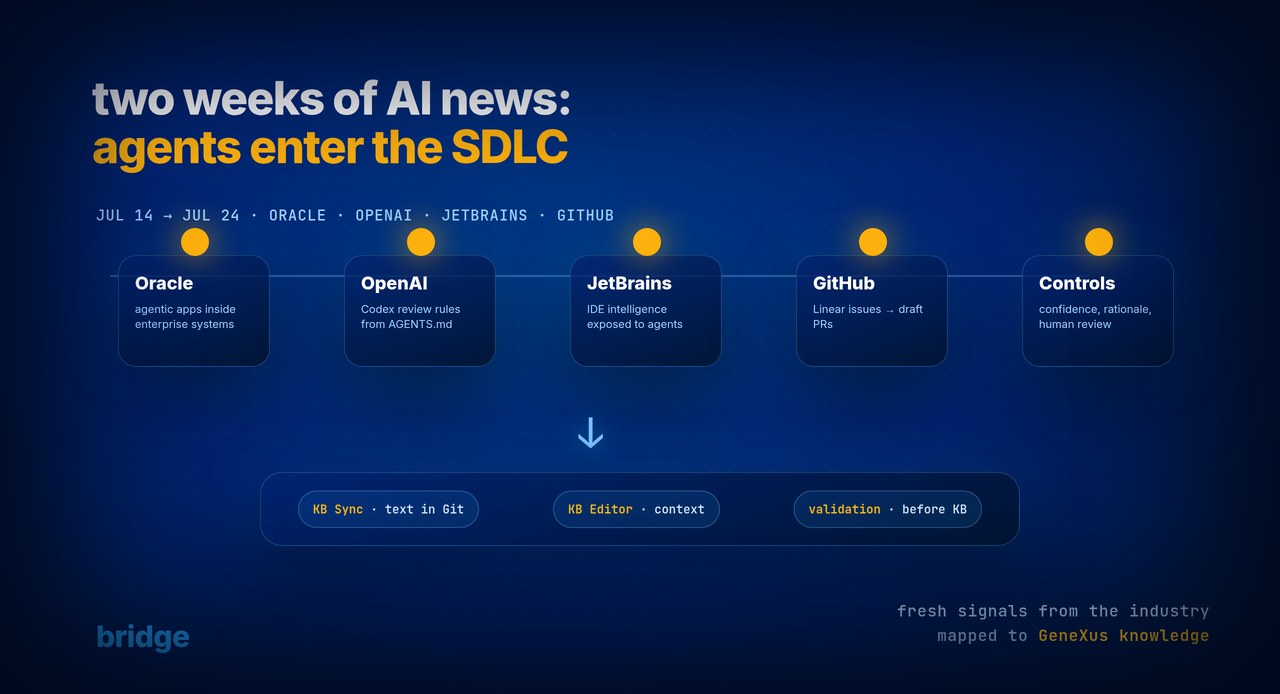
The news from these weeks is not that there are “more agents.” That stopped being news. The important signal is different: large software companies are no longer placing AI beside the system; they are moving it into the place where real work lives.
Oracle did it inside Fusion. OpenAI did it by turning repository instructions into review rules. JetBrains did it by opening IDE intelligence to agents. GitHub did it by connecting agents with issues, pull requests, confidence, rationale and human review.
Seen separately, they look like unrelated releases. Seen together, they point to a concrete thesis:
Useful enterprise AI is not AI that generates code outside the context. It is AI that operates near the system of truth, with rules, permissions, review and evidence.
For teams building on GeneXus, that sentence has a direct translation: the system of truth is not an ordinary folder of files. It is the Knowledge Base.
From external copilots to agents inside the system
In the first cycle of AI coding, AI lived outside. It was a chat, autocomplete, an extension inside the editor. We pasted part of the problem and hoped it returned something useful.
That works for small tasks. But in enterprise software, the value is not just writing a function. It is understanding the system where that function will live.
That is why Oracle's announcement matters. Oracle introduced a builder experience to create and run Fusion Agentic Applications inside Oracle Fusion Cloud Applications. The point is not the word “agentic.” The point is that the agents live where business objects, workflows, security, approvals and audit logs already exist.
That architecture says something important: it is not enough to connect AI to an application from the outside. The agent needs to operate near the business model, not as an occasional visitor.
GeneXus already has a structured business model. It is called the Knowledge Base.
Context is no longer documentation: it is operational control
OpenAI published another useful signal: Codex Code Review can use custom rules defined in AGENTS.md. This is not about formatting or style. It is about capturing rules a linter does not know: contracts that must not break, customer data that must not be logged, service boundaries, historical repository conventions.
OpenAI frames it well: tests and linters cover deterministic checks; repository rules capture contextual judgment.
In GeneXus, much of what matters lives exactly there:
- which objects are critical;
- which sections are owned by Patterns;
- which Procedures have operational impact;
- which conventions come from years in production;
- which changes require human review before touching the KB.
That knowledge is rarely in a tidy README. It often lives in the team's head, in the application's history, or inside the KB itself.
The opportunity is to turn that context into an operational layer for agents. Not just “explain GeneXus to the AI,” but tell it: in this KB, these are the rules of the game.
The IDE is becoming a source of truth too
JetBrains, with Rider 2026.2, pushed a similar idea from another angle: agents should not reconstruct everything from files and terminal output. They should use what the IDE already knows: coverage, profiler data, the refactoring engine, testing workflows, quality hooks.
The underlying message is simple: less guessing, fewer wasted tokens, safer changes.
That connects with KB Editor. An editor prepared for GeneXus is not just a place to write text. It is where the agent receives signals a generic editor does not have: GeneXus syntax, navigation, local documentation, language rules, externalized structure, synchronization state and validation.
AI improves when it stops guessing.
GitHub shows the missing piece: human review and evidence
GitHub connected Copilot cloud agent with Linear: assign an issue, the agent works in an ephemeral environment, opens a draft PR, streams progress and asks for human review.
The same day, GitHub introduced automation controls in Issues: suggested changes, confidence levels, rationale and actions pending review.
GitHub's clarification matters: approvals are a workflow convenience, not a security boundary. In other words: “human in the loop” does not replace real permissions, real limits or real validation.
For a GeneXus KB, that distinction matters a lot. An agent can propose. It can explain. It can open a diff. But before anything returns to the KB, the flow needs validation.
That is where KBbridge should not be seen as “another AI tool,” but as a bridge and control layer.
What this means for GeneXus
The reading is not “Oracle, GitHub or JetBrains will define how GeneXus development works.” They do not need to. The useful reading is deeper: the industry is converging on a way of working where agents need a readable, governed and auditable system of truth.
GeneXus already has an advantage many traditional stacks try to reconstruct: the application is modeled. The Knowledge Base contains objects, relationships, rules, properties, Patterns, transactions, procedures and APIs.
But there is a tension: if that KB stays locked in binary form, the agent cannot read it well. It cannot diff it. It cannot explain impact. It cannot leave clear evidence. It cannot work with Git the way the new tools do.
That is where KBbridge fits.
KBbridge externalizes the Knowledge Base to plain text, keeps it synchronized, makes it readable to any LLM and surrounds it with context: files for Claude, Codex, Copilot, Cursor and other agents; local GeneXus documentation through MCP; and validation before internalization.
It does not replace GeneXus. It does not compete with the platform. It does something more specific: it lets the KB participate in the agentic workflow the industry is building around Git, IDEs, issues, PRs and human review.
The question GeneXus teams should ask
It is not “which agent should I use?” That answer will keep changing.
The more stable question is:
Is my Knowledge Base ready for an agent to read it, respect it, propose changes and leave evidence before touching the real system?
If the answer is no, the problem is not the model. It is the missing bridge between knowledge and the modern workflow.
The news from these weeks all points to the same place: agents are entering the real SDLC. But they will only be useful in enterprise if they work near context, with rules, traceability and validation.
In GeneXus, that context exists. It is in the KB. KBbridge makes it accessible without taking it out of your control.
Sources
- Oracle — Oracle Introduces AI-Native Builder Experience to Create and Run Agentic Applications in Oracle Fusion Applications (July 14, 2026): oracle.com
- OpenAI — Custom Code Review rules for Codex (July 20, 2026): developers.openai.com
- JetBrains — Rider 2026.2: IDE Intelligence for AI Agents (July 22, 2026): blog.jetbrains.com
- GitHub — Copilot cloud agent for Linear is now generally available (July 23, 2026): github.blog
- GitHub — Agent automation controls in GitHub Issues in public preview (July 23, 2026): github.blog
How you try it
If you want to see how a GeneXus Knowledge Base becomes readable to agents, with text in Git, local documentation and validation before returning to the KB, start with Getting Started. There is a 15-day free trial, no card required, at kbbridge.com.