MCP, A2A and ACP: the protocols of the agentic era, explained plainly
If you keep half an eye on AI news, three acronyms show up everywhere: MCP, A2A and ACP. They look like alphabet soup, but the idea behind them is simple. They're the plumbing rules that let AI stop being an isolated chat and start doing things: reading your data, using your tools, coordinating with other programs. This post explains them in plain language —no AI expertise assumed— and at the end I'll show what they have to do with GeneXus and your Knowledge Base.
First: what is an "agent"?
A chatbot answers questions. An agent also acts: it searches, runs things, checks the result, corrects itself, and repeats until the task is done. The difference isn't the conversation — it's that an agent touches the real world.
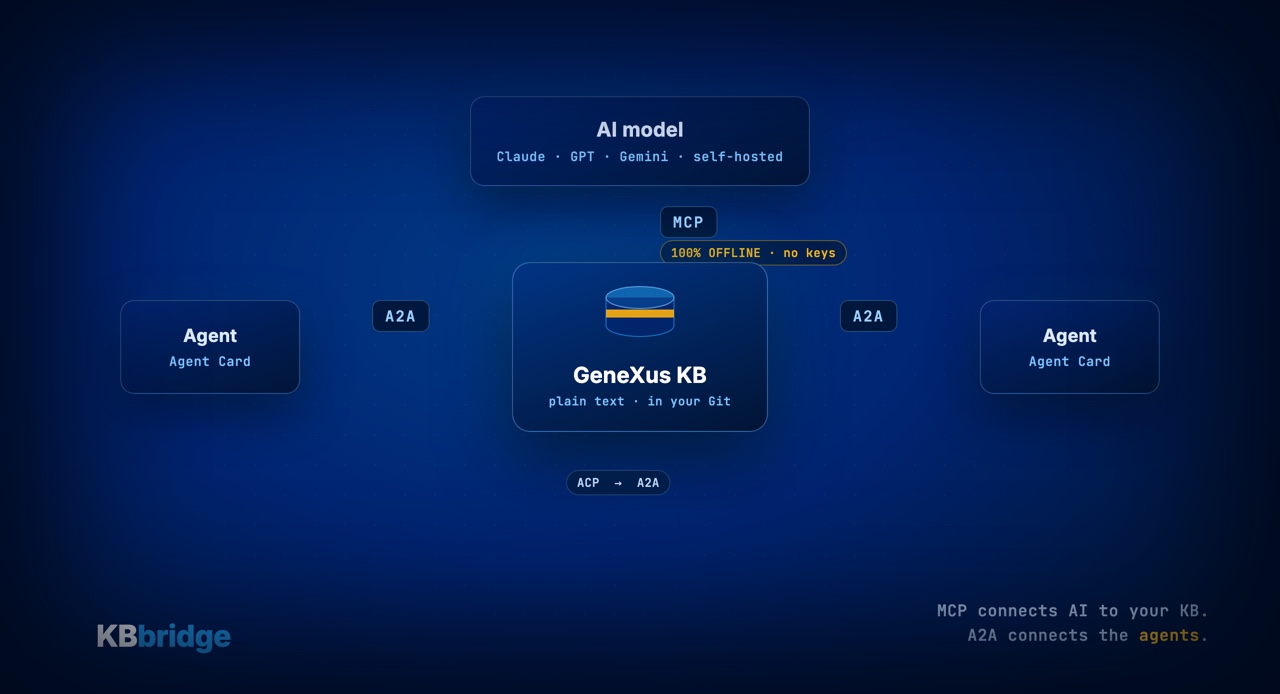
And to touch the real world it needs two things. One, to reach your tools and your data (your database, your repository, your documentation). Two, sometimes, to coordinate with other agents to split up a big job. Each of these three protocols solves one of those two needs. That's all you need to grasp to stop feeling lost.
MCP: how AI reaches your data and your tools
Imagine you hire a brilliant employee but lock them in an empty room: no phone, no access to the files, no database. However capable they are, they can't do anything. That's an AI model "on its own." MCP (Model Context Protocol) is the standardized door to that room: it gives the model orderly access to your tools and your data.
Anthropic launched it in late 2024 and it's now the de-facto standard: Claude, GPT, Gemini, Copilot, Cursor and almost everyone support it. It works on a client–server logic: you stand up an "MCP server" that exposes three things —tools (actions the AI can run, like a query against your database), resources (data and files it can read, like your documentation) and prompts (saved templates)— and any AI that speaks MCP connects and uses them.
Think of it as a vertical connection: the AI reaching down to your stuff.
A2A: how agents talk to each other
If MCP connects an agent to tools, A2A (Agent2Agent) connects agents to each other: like staff from different departments handing work back and forth. An agent building a quote asks another to validate credit, which in turn asks a third for the customer's data.
Google introduced it in April 2025 and the Linux Foundation now governs it, with more than 150 organizations behind it (AWS, Cisco, Google, IBM, Microsoft, Salesforce, SAP, ServiceNow). The key piece is the "Agent Card": a kind of business card —almost a résumé— where each agent advertises what it can do, so others can discover it and delegate tasks to it, even when they're built by different companies on different technologies.
Think of it as a horizontal connection: agent alongside agent.
So what about ACP?
Here's the part worth knowing so you don't get dizzy. ACP (Agent Communication Protocol) was a proposal from IBM (March 2025, inside its BeeAI project) to solve the same thing as A2A: letting agents communicate with each other.
But in August 2025 IBM and Google decided to join forces: ACP merged with A2A under the Linux Foundation, and ACP's own development is winding down. It wasn't a fight or a failure — it was a convergence, both communities pushing the same standard.
The lesson is worth gold: in young technology, standards consolidate fast. The acronym that was indispensable six months ago folds into another one today. So tying years of your work to one fashionable piece is a gamble.
The map, in one sentence
- MCP = vertical: an agent ↔ your tools, your data, your knowledge.
- A2A = horizontal: agent ↔ agent.
- ACP = folding into A2A; in practice you're left with two layers, not three.
With that you already understand 90% of what's being debated in the "agentic" world today.
What this has to do with GeneXus and KBbridge
Here's the point that matters if you build on GeneXus. The question isn't "does this replace GeneXus?" —it doesn't—. The question is: "how do I connect my 20 years of Knowledge Base to this new world?" That's the thesis of KBbridge, word for word: to be the bridge between GeneXus and AI.
And KBbridge already lives in the most important layer, MCP. It ships a local, 100% offline MCP server with 46,750 documentation chunks for GeneXus (versions 9 through 18) and three tools —search_docs, lookup_method, list_topics—, with no API keys and no outbound traffic. Translated: any AI that speaks MCP can query GeneXus knowledge, and nothing leaves your network.
There's more. Because KBbridge externalizes your KB to plain text, you can build your own MCP servers inside GeneXus. With a simple prompt, connecting Claude to KB Editor, I built an MCP server in about 6 hours, generated directly in GeneXus, with no need for Node.js or Python. That server is, in effect, an agent that tomorrow can take part in the A2A world —talk to other agents— without you ever leaving the platform.
And because KBbridge is provider-agnostic, you choose which AI to use: Claude, GPT, Gemini, or a self-hosted on-prem model for banking, government or air-gapped environments where nothing can leave the network. The plumbing (MCP, A2A) will keep changing —you just saw it with ACP merging into A2A—; your KB stays as text in your own Git, and the bridge keeps it plugged into whatever comes next. It's the same old GeneXus thesis —knowledge outlives technology— applied to the agentic era.
How you try it
If you want to see your own GeneXus KB talking to an AI over MCP, watch the short videos on Getting Started, or try it free for 15 days, no card required, at kbbridge.com.
Sources
- MCP — Anthropic's original announcement: Introducing the Model Context Protocol.
- A2A — the project at the Linux Foundation: Linux Foundation Launches the Agent2Agent Protocol Project; and a clear explainer from IBM: What Is the Agent2Agent (A2A) Protocol?.
- ACP → A2A — the merger announcement (August 2025): ACP Joins Forces with A2A under the Linux Foundation's LF AI & Data.